





Scouting America

Astronomy Merit Badge

Astronomy
Merit Badge

Scouting America Merit Badge Hub

Scouting America
Merit Badge Hub

Astronomy

Requirement Updates 2025

This Merit Badge’s Requirements have recently been updated in 2025 Scouting America Requirements (33216). Please read more about “Requirements” on the Merit Badge Hub homepage. The previous version of the Merit Badge requirements can be found in Scoutbook.

Astronomy Merit Badge Overview

In learning about astronomy, Scouts study how activities in space affect our own planet and bear witness to the wonders of the night sky: the nebulae, or giant clouds of gas and dust where new stars are born; old stars dying and exploding; meteor showers and shooting stars; the moon, planets, and a dazzling array of stars.
Astronomy_merit-badge-overview

Astronomy Merit Badge Requirements

The previous version of the Merit Badge requirements can be found in Scoutbook

The requirements will be fed dynamically using the scout book integration
NOTE: The official merit badge pamphlets are now free and downloadable HERE or can be purchased at the Scout Shop.
1. Do the following:

3. With the aid of diagrams (or real telescopes if available), do the following:

4. Do the following (if instruction is done in a planetarium, Scouts must still identify the required stars and constellations outside under the natural night sky):

5. Do the following:

6. Do the following:

7. Do the following:

8. With your counselor's approval and guidance, do ONE of the following:

9. Do ONE of the following:

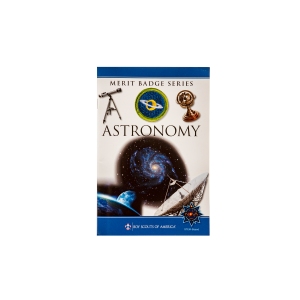
Get the Astronomy Merit Badge Pamphlet

Merit Badge Pamphlets are now free and publicly available. Note: Always check www.scouting.org/skills/merit-badges/all/ for the latest requirements.

Discover more about "Astronomy"

Make a detailed model of Earth and all its neighboring planets with this quick STEM-focused project. WHAT YOU’LL NEED Paint (red, orange, yellow, green, bluegreen, dark blue, cobalt blue, light blue, white and black) 8 small Styrofoam balls (these will be the planets). You’ll need the following sizes: 5, 4, 3, 2 ½, 2, 1 ½ and 1 ¼ inches. Make sure you have two each of the 1 ½- and 1 ¼-inch balls. 10-inch Styrofoam ball (this will be the base of the solar system) Coat hangers, wooden dowels or skewers (these will suspend the planets) Styrofoam sheet, pipe cleaners, cardboard or colored paper (this will make Saturn’s rings) Pocketknife or scissors WHAT YOU’LL DO STEP 1. Stick the hangers, skewers or dowels about halfway through all balls except the 10-inch one. STEP 2. Add detail to your planets by painting them. Do some research to decide exactly how you want to make each one look. For starters: SUN — 5-inch ball, bright yellow MERCURY — 1 ¼-inch ball, orange VENUS — 1 ½-inch ball, blue-green EARTH — 1½-inch ball, dark blue with green highlights MARS — 1 ¼-inch ball, red JUPITER — 4-inch ball, orange with red and white stripes. Be sure to add the Great Red Spot in the correct area with red paint. SATURN — 3-inch ball, yellow-orange URANUS — 2-inch ball, cobalt blue NEPTUNE — 2 ½-inch ball, light blue STEP 3. Make the stand. While you wait for the planets to dry, make the stand for your model. Cut the 10-inch ball in half, creating a dome with a flat bottom. Once all the planets are dry, stick them into the dome so each of them is arranged according to its order in the solar system. DON’T FORGET SATURN’S RINGS! Add some extra detail to your model by using pipe cleaners, extra Styrofoam, cardboard or colored paper to mimic Saturn’s famous rings. PHOTOS OF COMPLETED PROJECT Check out these photos of the completed solar system project sent to us by Boys’ Life readers. If you have a photos of a BL Workshop project, please use the form below to send them to us.

When the giant Magellan Telescope opens sometime in the next decade, it will be 10 times more powerful than the Hubble Space Telescope. But you don’t need billion-dollar equipment to introduce your Scouts to astronomy, according to veteran merit badge counselor Chris Smith of Allentown, Pa. Smith and his daughter, Kaitie, who often team-teach the Astronomy merit badge, shared their top tips with Scouting magazine. They are both with the Minsi Trails Council. Telescopes Although you don’t need an expensive instrument, you do need more than a discount-store telescope. “They’re difficult to use, and they give you such poor-quality images that it discourages kids,” Chris says. “If you show a kid a really good shot of Jupiter or Saturn through a good telescope, they’ll say, ‘Wow!’ almost every time, but if you use a poor telescope, you’ll have trouble even finding it.” If you don’t want to drop $400 or more on a good telescope, he recommends connecting with a local astronomy club, which will have access to high-quality instruments and — perhaps even better — people who know how to use them. Chris and Kaitie teach the badge through the Lehigh Valley Amateur Astronomy Society, whose Pulpit Rock Astronomical Park is perhaps the best amateur observatory east of the Mississippi. Teamwork Unless you’re teaching one Scout at a time, it’s good to have some help. “If there’s a leader who has his own telescope, I would recommend he do a crash course with a couple of other leaders in the troop without kids so that he’s not just on his own,” Chris says. That’s how former tagalong Kaitie started teaching. Once, when her dad was having trouble getting a telescope to sync with his computer, she grabbed his laser pointer and started telling Scouts the stories behind the constellations. “When I started teaching the stories, they got more interested in the constellations,” she says. “Instead of it just being a bunch of stars in the sky, there was now a story.” Teaching Tools That laser pointer, which is so bright that it looks like a lightsaber, is one of Chris’ favorite teaching tools. Another is the Evening Sky Map, available for free at skymaps.com “They publish a sky map for the month; on the front and back it has all kinds of information about stuff happening in the sky,” he says. Chris is also a fan of Stellarium (stellarium.org), which bills itself as “a free open source planetarium for your computer.” Of course, there are also plenty of smartphone apps available, but the Smiths recommend saving those for later to avoid distractions. Timing Spring and fall are the best seasons to work on the badge. “Astronomical twilight is at 8 or 9 o’clock,” Chris says. “No Scout leader is interested in keeping his kids up until 3 a.m.” But summer isn’t bad. When Kaitie was on staff at Trexler Scout Reservation in Kunkletown, Pa., last summer, she did some informal teaching. “Everyone was, like, lying on the ground looking at the sky while I was pointing things out and talking,” she says. “Everyone was so fascinated by it. I was so happy that they loved it.”

View Related Merit Badges

Chat Icon
Scoutly Toggle Size Close Chat