Adult leaders supervising activities afloat must have completed Safety Afloat training within the previous two years. Cub Scout activities afloat are limited to council, district, pack, or den events on calm or gently flowing water that do not include float trips (expeditions). Safety Afloat standards apply to the use of canoes, kayaks, rowboats, rafts, floating tubes, sailboats, motorboats (including waterskiing), and other small craft (Stand Up Paddle Boards).
Boating in Cub Scouting is designed to teach safety and introduce Cub Scouts to outdoor recreational activities.
Before starting this Adventure, all participants (youth and adults) must complete the Scouting America Swimmer Test. Cub Scouts who cannot complete the Scouting America Swimmer Test are not permitted to work on this Adventure. This is Requirement 1 for each of the paddle craft Adventures.
This meeting is designed so that each Cub Scout has access to their own paddle craft. Paddle crafts are limited to canoes, kayaks, and stand-up paddle boards. Each Cub Scout may choose a different paddle craft to earn their Adventure. Make sure all equipment is the proper size for Cub Scouts. Choosing a paddle craft is requirement 2 for each of the paddle craft Adventures.
For safety reasons and developmental reasons, there are no paddle craft Adventures for Lion, Tiger, and Wolf Cub Scouts. Lion, Tiger, and Wolf Cub Scouts may participate in age- appropriate boating activities in accordance with the Guide to Safe Scouting and the Scouting America Aquatics Management Guide, but may not work on the requirements for any of the paddle sports Adventures.
All participants in official Scouting America activities should become familiar with the Guide to Safe Scouting and applicable program literature or manuals.
Be aware of state or local government regulations that supersede Scouting America practices, policies, and guidelines.
To assist in the safe delivery of the program you may find specific safety items that are related to requirements for the Adventure.
Before a Scouting America group may engage in any watercraft activity adult leaders for such activity must complete Safety Afloat training, have a commitment card, and be dedicated to full compliance with all nine points of Safety Afloat. (Through enforcement of these nine measures, most watercraft accidents can be prevented.) At least one of the adult leaders must be trained in CPR. Safety Afloat training may be obtained from my.scouting.org, at council summer camps, and at other council and district training events. – Supervision by an adult, 21 or older, who is trained in Scouting America Safety Afloat. At least one leader must be trained in first aid which includes CPR. Any swimming done in conjunction with the activity must be within Scouting America Safe Swim Defense standards.
The following information is specific to Cub Scout boating activities:
Supervision—the ratio of adult supervisors to participants is one to five.
Skill Proficiency—Canoeing, rowboating, and rafting for Cub Scouts (including Webelos Scouts) is limited to council/district events on flat-water ponds or controlled lake areas free of powerboats and sailboats. Prior to recreational canoeing, Cub Scouts are to be instructed in basic handling skills and practices.
Planning—Canoeing, rowboating, and rafting do not include “trips” or “expeditions” and are not to be conducted on running water (i.e., rivers or streams); therefore, some procedures are inapplicable. Suitable weather requires clear skies, no appreciable wind, and warm air and water.
Life jackets—All persons engaged in activity on the open water must wear properly fitted U.S. Coast Guard-approved life jackets.
Supervision by an adult, 21 or older, who is trained in Scouting America Safety Afloat. At least one leader must be trained in first aid which includes CPR. Any swimming done in conjunction with the activity must be within Scouting America Safe Swim Defense standards.
Complete Scouting America Safety Afloat (30 minutes) training on my.scouting.
Confirm enough adults who will serve as supervisors during the activity to maintain aratio of one supervisor to every 5 Cub Scouts.
Have buddy tags for everyone who will be near the water, youth, and adults.
Provide continuous, qualified adult supervision and discipline during the ride.
Buddy Cub Scouts based on skill level.
During the Adventure:
Give an overview and instruction on the points of Safety Afloat prior to the activity.
Provide continuous, qualified adult supervision and discipline during the activity.
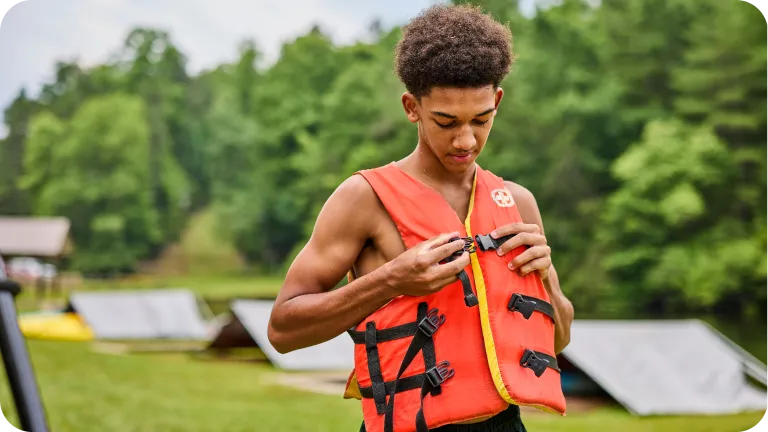
All participants, both Cub Scouts and adults, must wear a life jacket during boating activities. Review the Life Jackets / Personal Flotation Devices Safety Moment.
Before the Meeting
This meeting will take place at a location where Cub Scouts and family members have access to the proper equipment, the chosen paddle craft to complete the Adventure, and the water is flat and calm.+
There must be a designated swimming area where Webelos and Arrow of Light Scouts can jump feet first in water over their head while wearing a life jacket and swim 25 feet wearing the life jacket.
All participants (Cub Scouts and adults) have passed the Scouting America swimmer test and are classified as a “swimmer”.
It is best to communicate details in a written form that is distributed to parents and legal guardians, and referred to often, as this will help ensure everyone is well-informed and prepared.
30 days before the meeting, confirm access to the meeting location.
30 days before the walk, confirm date, time, and location.
Purchase supplies, including Adventure loops and pins.
7 days before the meeting, send out a meeting reminder.
3 days before the meeting, send out a second meeting reminder.
The morning of the meeting, send out a third meeting reminder.
Remind everyone to bring their fishing gear, camp chair, and Cub Scout Six Essentials.
On the day of the meeting, get to the location early to mark out fishing areas.
Set Up Den Meeting Breakouts.
Set Up Activity Stations.
At Home Requirements
Send a reminder for everyone to bring towels, bathing suits, and life jackets, and Cub Scout Six Essentials.
During The Meeting
Pack Meeting Gathering Activity
As Cub Scouts arrive, have a check-in station and have someone check their life jackets.
Opening Ceremony and Remarks
Opening Remarks
“Welcome, Cub Scouts, to our paddle craft pack meeting. Let’s remember that being safe is a big part of being a responsible Cub Scout. Being safe means more than just following rules—it means being aware, caring for others, and always doing our best to keep ourselves and those around us out of harm’s way.”
Give directions on den breakouts/den meetings.
Den Break Outs
No Den Break Outs for this meeting.
Activity Stations
There is no rotation of stations in this meeting. If you have a large group of Cub Scouts, and enough adults, you may create rotation stations. Cub Scouts are to be instructed by a knowledgeable adult and the overall activity is supervised by an adult leader who has completed Safety Afloat and all safety measures are in place.
All paddle craft Adventures have 30 minutes for Cub Scouts to practice and enjoy their paddle craft.
Presentations and Ceremonies
Present paddle sport Adventure loops and pins to Cub Scouts.
Cubmaster Minute
“Cub Scouts, this month we’ve had some fun on the water. We grabbed onto a paddle and a boat, and power stroked our way to success.
When you repeat the Scout Oath, the words “Do My Best” are often lost among the other important words. Let’s stop for a minute to consider what those words, Do My Best, really mean.
BEST describes actions and effort well above the usual performance. You are the only one who can possibly know whether or not you have done your best. Don’t you think that everyone deserves “the best”? It has to start somewhere; you may as well be the one to do “my best” first.
Think about the meaning of the Scout Oath and decide you will always do your best, no matter what. You will be the one who benefits the most!”
Remind everyone of the next pack meeting or activity.