
Scouting America

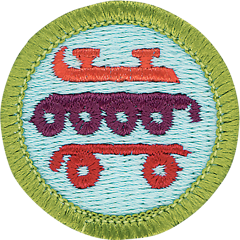
Skating Merit Badge

Skating
Merit Badge

Scouting America Merit Badge Hub

Scouting America
Merit Badge Hub

Skating

Requirement Updates 2026

This Merit Badge’s Requirements have recently been updated in 2025 Scouting America Requirements (33216). Please read more about “Requirements” on the Merit Badge Hub homepage. The previous version of the Merit Badge requirements can be found in Scoutbook.


Skating Merit Badge Overview

This merit badge introduces Scouts to the exciting world of ice skating, roller skating, in-line skating, and skateboarding. In addition to being an enjoyable leisure activity that promotes fitness, there are a variety of athletic careers in skating.
Skating_merit-badge-overview

Skating Merit Badge Requirements

The previous version of the Merit Badge requirements can be found in Scoutbook

The requirements will be fed dynamically using the scout book integration 108
NOTE: The official merit badge pamphlets are now free and downloadable HERE or can be purchased at the Scout Shop.
1. Do the following:
  • (a) Explain to your counselor the most likely hazards associated with skating and what you should do to anticipate, help prevent, mitigate, and respond to these hazards.
  • (b) Show that you know first aid for injuries or illnesses that could occur while skating, including hypothermia, frostbite, lacerations, abrasions, fractures, sprains and strains, concussions, blisters, heat-related reactions, and shock.

2. Working under the supervision of an experienced adult, do ONE of the following options.
  • Option A—Ice Skating. Do ALL of the following:
  • (1) Explain the general safety and courtesy guidelines for ice skating.
  • (2) Discuss preparations that must be taken when skating outdoors on natural ice. Explain how to make an ice rescue.
  • (3) Discuss the parts and functions of the different types of ice skates.
  • (4) Describe the proper way to carry ice skates at the rink and for travel.
  • (5) Describe how to store ice skates for long periods of time, such as seasonal storage.
  • (6) Skate forward at least 40 feet and come to a complete stop. Use either a two-foot snowplow stop or a one-foot snowplow stop.
  • (7) After skating forward, glide forward on two feet, then on one foot, first right and then left.
  • (8) Starting from a T position, stroke forward around the test area, avoiding the use of toe picks if wearing figure skates.
  • (9) Glide backward on two feet for at least two times the skater's height.
  • (10) Skate backward for at least 20 feet on two skates.
  • (11) After gaining forward speed, glide forward on two feet, making a turn of 180 degrees around a cone, first to the right and then to the left.
  • (12) Perform forward crossovers in a figure-eight pattern.
  • (13) Explain to your counselor the safety considerations for participating in an ice-skating race.
  • (14) Perform a hockey stop.
  • Option B—Roller Skating. Do ALL of the following:
  • (1) Explain the general safety rules and etiquette guidelines for roller skating.
  • (2) Discuss the parts and functions of a roller skate and their functions.
  • (3) Describe five essential steps to good roller skate care.
  • (4) Skate forward with smooth, linked strokes on two feet for at least 100 feet in both directions around the rink and demonstrate proper techniques for stopping.
  • (5) Skate forward and glide at least 15 feet on one skate, then on the other skate.
  • (6) Perform a forward crossover.
  • (7) Skate backward for at least 40 feet on two skates, then for at least 15 feet on one skate.
  • (8) Skate forward in a slalom pattern for at least 40 feet on two skates, then for at least 20 feet on one skate.
  • (9) Skate backward in a slalom pattern for at least 15 feet on two skates.
  • (10) Shuttle skate once around the rink, bending twice along the way, without stopping.
  • (11) Perform a series of two consecutive spins on skates, OR hop, skip, and jump on skates for at least 10 feet.
  • (12) Perform a stepover.
  • (13) While skating, dribble a basketball at least 40 feet, then back to your starting position, OR push a hockey ball with a stick at least 40 feet, then back to your starting position.
  • Option C—In-Line Skating. Do ALL of the following:
  • (1) Explain the general safety rules and courtesy guidelines for in-line skating.
  • (2) Describe the parts of an in-line skate and their functions.
  • (3) Describe the required and recommended safety equipment for in-line skating.
  • (4) Explain four essential steps to good in-line skate care.
  • (5) Skate forward with smooth, linked strokes on two feet for at least 100 feet.
  • (6) Skate forward and glide at least 15 feet on one skate, then on the other skate.
  • (7) Stop on command on flat pavement using the heel brake.
  • (8) Perform a forward crossover.
  • (9) Perform a series of forward, linked swizzles for at least 40 feet.
  • (10) Skate backward for at least 40 feet in a series of linked, backward swizzles.
  • (11) From a strong pace, perform a lunge turn around an object predetermined by your counselor.
  • (12) Perform a mohawk.
  • (13) Perform a series of at least four one-footed downhill slaloms on pavement with a gentle slope.
  • (14) Describe how to pass a pedestrian or another skater from behind.
  • (15) Describe at least three ways to avoid an unforeseen obstacle while skating.
  • (16) Describe two ways to get on and off a curb, and demonstrate at least one of these methods.
  • Option D—Skateboarding. Do ALL of the following:
  • (1) Explain the history and evolution of skateboarding.
  • (2) Describe the benefits of skateboarding (physical fitness, balance, coordination, perseverance, and creativity)
  • (3) Explain the safety rules and courtesy guidelines for skateboarding, including right-of-way and communication signals and warnings.
  • (4) Explain the protective gear needed to skate safely, including helmet, knee pads, elbow pads, and wrist guards, and show how to wear them correctly.
  • (5) Describe the two main styles of skateboarding (street and vert), and describe common skatepark features (ramps, manual pad, rails, spine, etc.).
  • (6) Explain skateboard anatomy (deck, trucks, wheels, hardware, etc.).
  • (7) Build a board by assembling all pieces (deck, wheels, trucks, hardware, and grip tape) in the proper order.
  • (8) Explain skateboard maintenance (cleaning, adjusting bolts, and replacing parts).
  • (9) Explain the difference between regular and goofy stance, and demonstrate your preferred stance.
  • (10) Demonstrate how to push, cruise, and carve on flat ground.
  • (11) Show at least two braking and stopping techniques.
  • (12) Do a basic ollie and at least one variation.
  • (13) Show how to drop-in from coping.
  • (14) Demonstrate THREE skateboarding tricks from the following types:
  • (a) Flat ground tricks
  • (b) Flip and shove-it tricks
  • (c) Grind and slide tricks
  • (d) Air and grab tricks
  • (e) Footplant tricks.

USA Skateboarding Sponsored Resource Videos

Requirement C
Requirement A3
Requirement D2
Requirement D3
Requirement E
Requirement E
Requirement D5
Requirement E

Get the Skating Merit Badge Pamphlet

Merit Badge Pamphlets are now free and publicly available. Note: Always check www.scouting.org/skills/merit-badges/all/ for the latest requirements.

Shop Skating Merit Badge Products

As the exclusive retailer of Scouting America, 35% of every Scout Shop purchase supports the future of Scouting.


View Related Merit Badges

Chat Icon
Scoutly Toggle Size Close Chat
New Digital Resource Guide Available

The Family Life Digital Resource Guide was recently published. Check it out today!