Scouting America

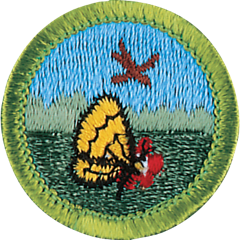
Nature Merit Badge

Eagle Scout insignia Eagle Required

Nature
Merit Badge

Scouting America Merit Badge Hub

Scouting America
Merit Badge Hub

Nature

Requirement Updates 2025

This Merit Badge’s Requirements have recently been updated in 2025 Scouting America Requirements (33216). Please read more about “Requirements” on the Merit Badge Hub homepage. The previous version of the Merit Badge requirements can be found in Scoutbook.

Nature Merit Badge Overview

There is a very close connection between the soil, the plants, and all animal life, including people. Understanding this connection, and the impact we have upon it, is important to preserving the wilderness, as well as to our own well-being as members of the web of nature.
Nature_merit-badge-overview

Nature Merit Badge Requirements

The previous version of the Merit Badge requirements can be found in Scoutbook

The requirements will be fed dynamically using the scout book integration 79
Note: In most cases all specimens should be returned to the wild at the location of original capture after the requirements have been met. Check with your counselor for those instances where the return of these specimens would not be appropriate.

Under the Endangered Species Act of 1973, some plants and animals are or may be protected by federal law. The same ones and/or others may be protected by state law. Be sure that you do not collect protected species.

Your state may require that you purchase and carry a license to collect certain species. Check with the wildlife and fish and game officials in your state regarding species regulations before you begin to collect.

NOTE: The official merit badge pamphlets are now free and downloadable HERE or can be purchased at the Scout Shop.
1. Name three ways in which plants are important to animals. Name a plant that is protected in your state or region, and explain why it is at risk.
Resources: Why Animals Need Plants (video)
11 Plants That Use Animals to Do Their Dirty Work (website)
2. Name three ways in which animals are important to plants. Name an animal that is protected in your state or region, and explain why it is at risk.
Resource: How Do Animals Help Plants? (4 Symbiotic Interactions) (website)
3. Explain the term "food chain." Give an example of a four-step land food chain and a four-step water food chain.
Resources: Food Chains and Food Webs (video)
Food Chains in the Everglades (video)
4. Do all the requirements in FIVE of the following fields:

5. Discuss the importance of the Leave No Trace Seven Principles and the Outdoor Code and how they relate to nature. Explain how you have followed the Leave No Trace Seven Principles and the Outdoor Code while in natural areas during field observation, specimen collection, and identification.
Resources: The Outdoor Code Explained (video)
What is Leave No Trace? (video)
Leave No Trace Basics (video)
6. Do the following:
  • (a) Explain what succession is to your counselor.
    Resources: Ecological Succession (video)
    Ecological Succession: Change Is Good (video)
  • (b) Visit a natural area (forest, grassland, meadow, water feature) and explain what stage of succession (both plant and animal) the area is in. Talk about what community/succession stages may have been there before and what community/succession stages may replace what you see now. Discuss what disturbances or changes have taken place in the past to create this landscape and what changes may occur in the future to change the landscape further.
    Resource: Ecological Succession-Primary and Secondary (video)

7. Do ONE of the following:

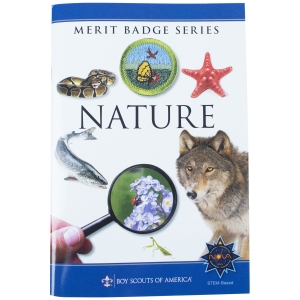
Get the Nature Merit Badge Pamphlet

Merit Badge Pamphlets are now free and publicly available. Note: Always check www.scouting.org/skills/merit-badges/all/ for the latest requirements.

Shop Nature Merit Badge Products

As the exclusive retailer of Scouting America, 35% of every Scout Shop purchase supports the future of Scouting.

View Related Merit Badges

Chat Icon
Scoutly Toggle Size Close Chat