



Scouting America

Citizenship in the World
Merit Badge
Scouting America Merit Badge Hub
Eagle Scout insignia Eagle Required
The Digital Resource Guide for this Merit Badge is Available Now!

Explore, learn, and complete your merit badge step by step—your journey starts here!

Requirement Updates 2026

This Merit Badge’s Requirements have recently been updated in 2025 Scouting America Requirements (33216). Please read more about “Requirements” on the Merit Badge Hub homepage. The previous version of the Merit Badge requirements can be found in Scoutbook.

Citizenship in the World

Merit Badge Overview

Scouts who earn the Citizenship in the World merit badge will discover that they are already a citizen of the world. How good a citizen each person is depends on his willingness to understand and appreciate the values, traditions, and concerns of people in other countries.
Citizenship-in-the-World_MB-overview

Citizenship in the World

Merit Badge Requirements

The previous version of the Merit Badge requirements can be found in Scoutbook

The requirements will be fed dynamically using the scout book integration
NOTE: Check out the Digital Resource Guide for the Citizenship in the World merit badge HERE for information and helpful resources to engage your learning and assist you along on your merit badge journey!
The official merit badge pamphlets are now free and downloadable HERE or can be purchased at the Scout Shop.
1. Explain what citizenship in the world means to you and what you think it takes to be a good world citizen.
Resources: What Does It Mean To Be a Global Citizen? (video)
What Is Global Citizenship? (video)
2. Explain how one becomes a citizen in the United States, and explain the rights, duties, and obligations of U.S. citizenship. Discuss the similarities and differences between the rights, duties, and obligations of U.S. citizens and the citizens of two other countries.
Resources: What Is Citizenship? (video)
A Guide to the Bill of Rights (video)
Duties and Obligations of Being a Filipino Citizen (video)
Fundamental Duties as a Citizen of India (video)
3. Do the following:

4. Do TWO of the following:

5. Do the following:

6. Do the following:

7. Do TWO of the following (with your parent or guardian's permission) and share with your counselor what you have learned:

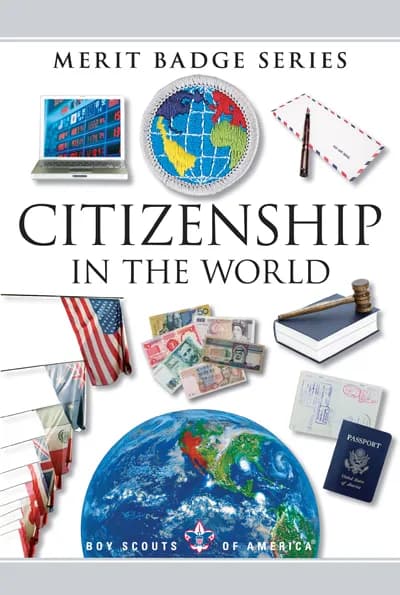
Get the Citizenship in the World Merit Badge Pamphlet

Merit Badge Pamphlets are now free and publicly available. Note: Always check www.scouting.org/skills/merit-badges/all/ for the latest requirements.

Discover more about

"Citizenship in the World"

IN AN ERA WHEN global events often dominate headlines, Citizenship in the World might be among Scouting’s most important merit badges. It might also be among the least exciting to earn. Citizen In World Merit Badge Handled incorrectly, the Citizenship in the World badge can seem like an endless slog through vocabulary lists. Handled correctly, it can help Scouts understand what it means to be a citizen in a global society. The merit badge underwent recent review and approval by United Nations staff members Amy Ruggiero and Troy Wolfe to make sure it’s reflective of today’s international environment. Scouter Steve Molde has discovered ways to add excitement to sometimes-dull topics. A merit badge counselor from St. Cloud, Minn., Molde often teaches Citizenship at a merit badge clinic in nearby Avon, one of America’s smallest and least-diverse communities. As of the 2010 census, Avon had 1,396 residents, 97.85 percent of whom were white. Yet in recent years, Molde has brought the world to the town by involving guests from Benin, Burkina Faso, China, Colombia, India, Mexico, Nigeria, Somalia and Sudan. “I encourage them to share customs, culture, government, economy, the struggles of the country, what the country excels at, what the country needs help with,” he says. So how does Molde find so many international representatives in landlocked Minnesota? Most are students at a local university, which offers foreign students in-state tuition if they meet certain requirements such as completing two “cultural sharing activities” each semester. Others are members of the town’s growing immigrant community, including the pastor who leads a Sudanese ministry run by his troop’s chartered organization. Whether they’re students or immigrants, Molde’s guests assist with requirement No. 2 (explain citizenship rights, duties and obligations) and No. 3 (study a world event and a foreign country). “The Scouts who attend this particular event are from small farming communities that don’t get a lot of exposure to people from other countries,” he says. “They find out that people from other countries are more like us than different from us.” That’s also a lesson Scouter Ian Greig learned long ago. A naturalized U.S. citizen who grew up in Great Britain, Greig has worked in Australia, the Philippines and the Dominican Republic. In his role as international representative for the Gulf Ridge Council, Greig leads regular Citizenship in the World clinics for Tampa-area Scouts. Greig’s international experience comes in handy, especially when he’s talking about different forms of government (requirement No. 5). “That’s the hardest thing for boys to understand,” he says. “The average Scoutmaster here wouldn’t be able to explain all the intricacies of a parliamentary system, because he isn’t experienced with it. He would have to explain it from a book. I grew up with it, and I can answer all of their questions.” Well, most of their questions. Greig and his fellow counselors are careful not to pass judgment on other countries and forms of government. “We don’t say one system is better than another,” he says. “We’re out to explain that to be good citizens of the world, you’ve got to try to understand how other countries run.” Whenever possible, Greig suggests offering examples that are relevant to Scouts. “You can say, ‘There is such a thing as international aviation law,’  but I don’t,” he explains. “I ask, ‘Suppose a plane takes off from here and flies to France? When the pilot gets to France, he calls on the radio. What happens if the landing officer doesn’t speak English?’  ” He then explains how international law requires all pilots and air traffic controllers to know English. Flags don’t usually have a story to tell, but they’re another way to pique Scouts’ interest. By describing the components of the Union Jack, which combines the crosses of St. George (England), St. Andrew (Scotland) and St. Patrick (Ireland), Greig helps Scouts understand the relationship among those three countries. “That grips their interest,” he says. “Lecturing to the boys doesn’t work,” Molde says. “Expecting them to read several chapters in a book doesn’t work. They need to be a little more hands-on one way or another. That’s where the challenge comes in.” It’s a challenge that counselors like he and Greig regularly rise to meet.
Before she taught her Scouts what it takes to become a U.S. citizen (requirement 2 of the Citizenship in the World merit badge), Crystal Bueno didn’t do any research. Instead, the naturalized citizen from Canada grabbed her thick stack of immigration paperwork — oh, and the X-rays proving she doesn’t have tuberculosis. “The Scouts were so happy to see all that stuff, to touch all that stuff, to understand,” the New York Scouter says. Seeing and touching stuff was just one way she brought the badge to life for the members of Troop 187 in Brooklyn. Power From the People One of the highlights of the multiweek class was a panel discussion featuring troop parents who grew up in countries from India to Ecuador. “A lot of our Scouts are first- generation Americans,” she says. “So, having their parents and other family members participate on a panel discussion about growing up in another country — what’s the same, what’s different, about food, culture, religion, holidays, different forms of government — was an amazing and enlightening experience.” (The discussion related to requirements 3b, 5 and 7c.) Bueno thinks troops anywhere can find similar resources if they look for them. “I think these resources exist if people have the imagination to search for them,” she says. “Look for international events or restaurants or ethnic festivals.” Show and Tell Bueno’s show and tell didn’t end with her lung X-rays. She also pulled together a collection of old passports to make requirement 6c (passports and visas) more meaningful. “The Scouts just loved flipping through them and making fun of our bad passport photos,” she says. And a collection of Scouting stamps from an aunt offered a fun way to introduce the World Organization of the Scout Movement (requirement 4c). “It must have been 25 or 30 different countries,” she says. “We just spread out the stamps and had the kids match up the stamps with the countries.” Avoiding Assumptions For requirement 3a (discuss a current world event), Bueno had Scouts debate U.S. involvement in Syria’s civil war and the humanitarian crisis in Venezuela. And she was sure to provide context, including telling the story of a Syrian family that emigrated to Canada and created a beloved chocolate company. “To get 11-, 12-, 13-year-olds to read the news and understand what’s happening, it doesn’t have context,” she says. “But when you’re able to make it a personal story, then they appreciate it.” Similarly, when it came time to compare the rights, duties and obligations of citizens in different countries (another part of requirement 2), she had the group create the first chart together, then assigned a second chart for homework. Bueno’s advice to other counselors is simple: “Do whatever you can to make it hands-on and interactive, and not just a dry lecture. This is such an important badge. To understand your place as a world citizen is such a huge thing to wrap your head around and to learn and to appreciate.”
In Partnership with

View Related Merit Badges

Chat Icon
Scoutly Toggle Size Close Chat
New Digital Resource Guides Available

New digital resource guides for two merit badges, Scholarship and Personal Fitness, are now available. No pamphlet required, check them out today!